
How can Roblox be used in speech therpay?
Why Motivation Matters in Speech Therapy
One of the strongest predictors of therapy success is practice frequency — not just in sessions, but between them.
Yet many children:
Resist worksheets
Disengage from repetitive drills
Avoid homework tied to speech therapy
This is where game-based motivation becomes clinically relevant.
Children already want to play Roblox. The therapeutic question is not whether children use games — but whether we can structure play so it supports learning rather than replaces it.
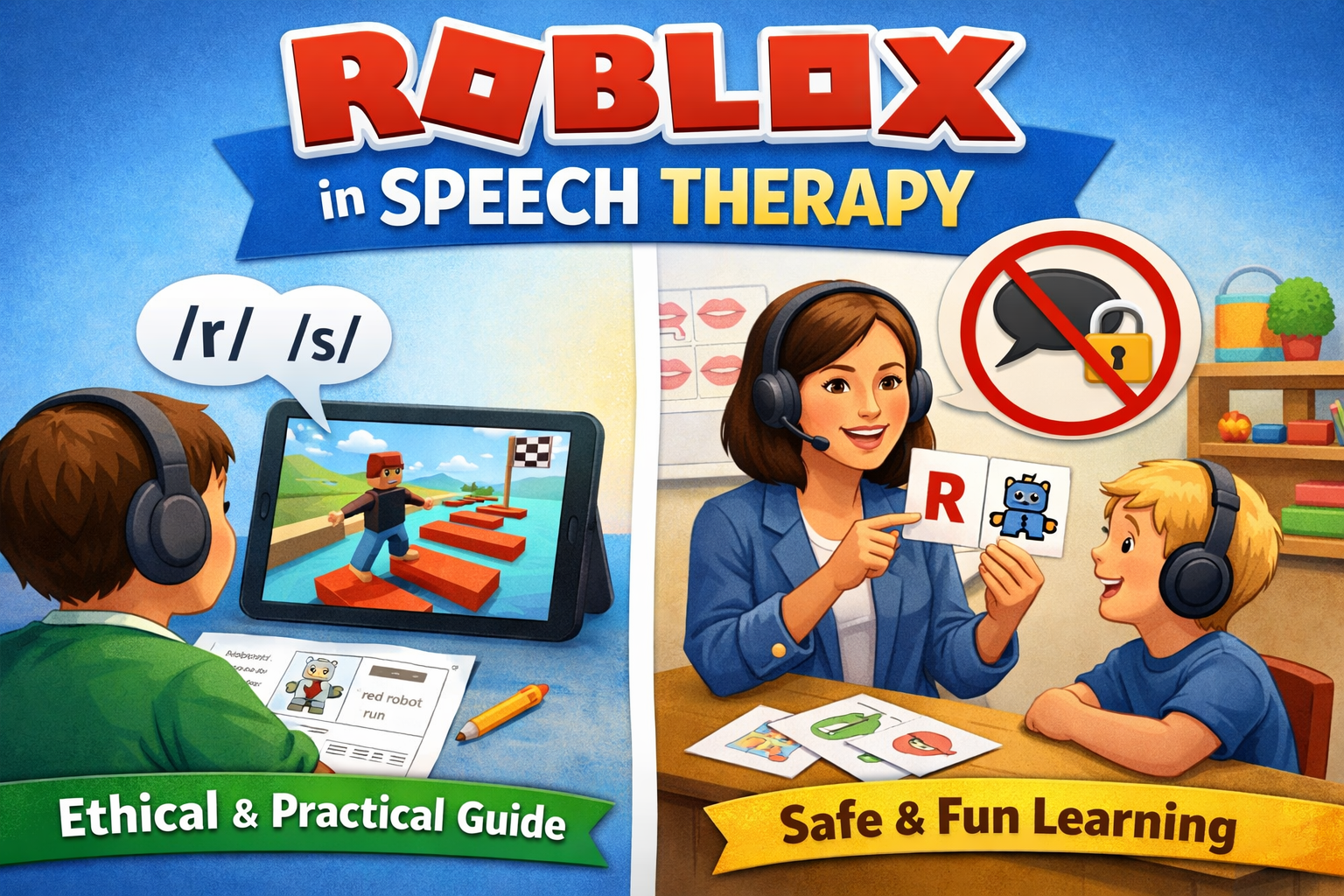
Roblox may be a useful platform for repetitive practice in Speech Therapy.
What makes Roblox different from other games?
Roblox is not a single game. It is a platform that allows for:
Simple, repetitive game mechanics
Obstacle-based progression (“obbies”)
Custom environments with minimal cognitive load
From a therapy perspective, this matters because:
Speech practice benefits from repetition
Learning improves when cognitive demands are controlled
Motivation increases when effort leads to visible progress
Used intentionally, Roblox can function as a reinforcement framework, not a distraction.
When Roblox Can Support Speech Therapy
Roblox may be suitable when the following are true:
Practicing an already established sound, like R or S
The child shows lack of motivation
The Game is not the Therapy
There`s a lot of games on Roblox, espacially Obbyes. In these games there is not any speech therapy tasks. If such games are to be used, it is important that speech therapy targets are available outside of the game, like a low tech list of targets words. In the games we have developed, speech therapy targets are already placed in the game. It is crucial that an adult motivates the child to do the tasks in or outside of the game.
Practical Ways to Use Roblox in Speech Therapy
The child says the target word
The adult confirms accuracy
The child moves on to next obstacle
Ethical Considerations
Roblox should:
Be time-limited
Serve a defined purpose
Replace less effective tasks — not add more screen exposure
Short, structured use is fundamentally different from passive gaming.
Commercial Platforms
Ethical use requires transparency:
Roblox is not a medical device
Access should never be mandatory
Alternative non-digital options must exist
Parents should understand why a game is used and what it supports.
What Roblox Cannot Replace
Roblox does not replace:
Clinical assessment
Phonetic placement instruction
Clinical judgment
Human interaction
Speech therapy is relational. Games are tools — not therapists.
Why Combining Printable Resources with Digital Play Works Best
Research and clinical experience both suggest that generalization improves when practice varies.
Combining:
Printable games (tactile, visual, low-tech)
Digital games (motivating, structured, repeatable)
…supports learning across contexts.
This is why many therapists use hybrid models, where:
PDFs guide speech targets
Digital games support repetition and motivation
Adults remain active facilitators
A Balanced Conlusion
Roblox is neither a miracle solution nor a threat to therapy.
Used carelessly, it adds noise.
Used ethically and intentionally, it can:
Increase practice frequency
Reduce resistance
Support carryover — especially at home
The question is not “Should we use Roblox in speech therapy?”
But rather:
“Are we using it with purpose, boundaries, and respect for the child?”
When the answer is yes, Roblox can become a useful supplement — not a shortcut.
Chat and Communication
To support child safety and reduce unnecessary distractions during speech practice, the chat function has been disabled in the therapeutic game environments used alongside our materials. This means that children cannot send or receive text messages from other players while using these games.
Disabling chat helps ensure that the focus remains on structured speech practice, minimizes exposure to inappropriate language or unsolicited interaction, and supports safer use in both home and clinical settings. Importantly, speech practice itself always takes place outside the game, guided by a parent or speech-language pathologist. The game environment functions solely as a controlled, non-verbal reinforcement tool — not as a social or communicative platform.